Part I: Tracking Earthquakes
Earthquake No. 1
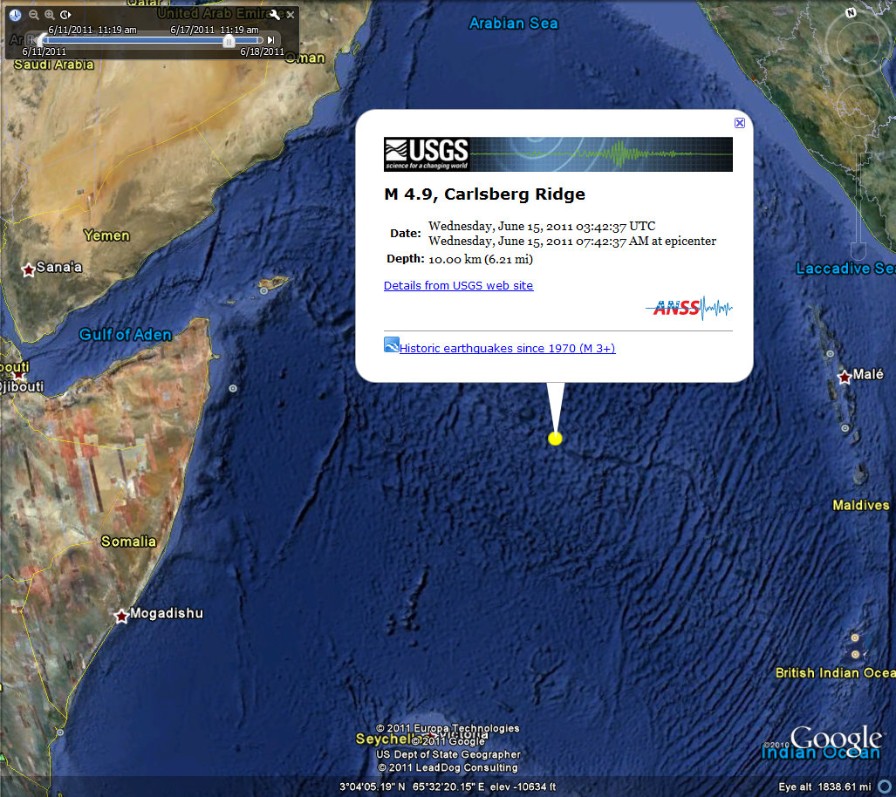
A 4.9 magnitude earthquake struck the Carlsberg Ridge on June 15, 2011 at 7:42AM local time. The focus depth of the earthquake was 10km. The earthquake happened near a divergent boundary. Earthquakes occur along divergent boundaries because the tectonic plates are moving away from each other. Often, sea-floor spreading occurs at mid-ocean ridges. These ridges develop extension cracks where the lithosphere breaks or rifts apart. This movement often results in earthquakes.
Earthquake No. 2
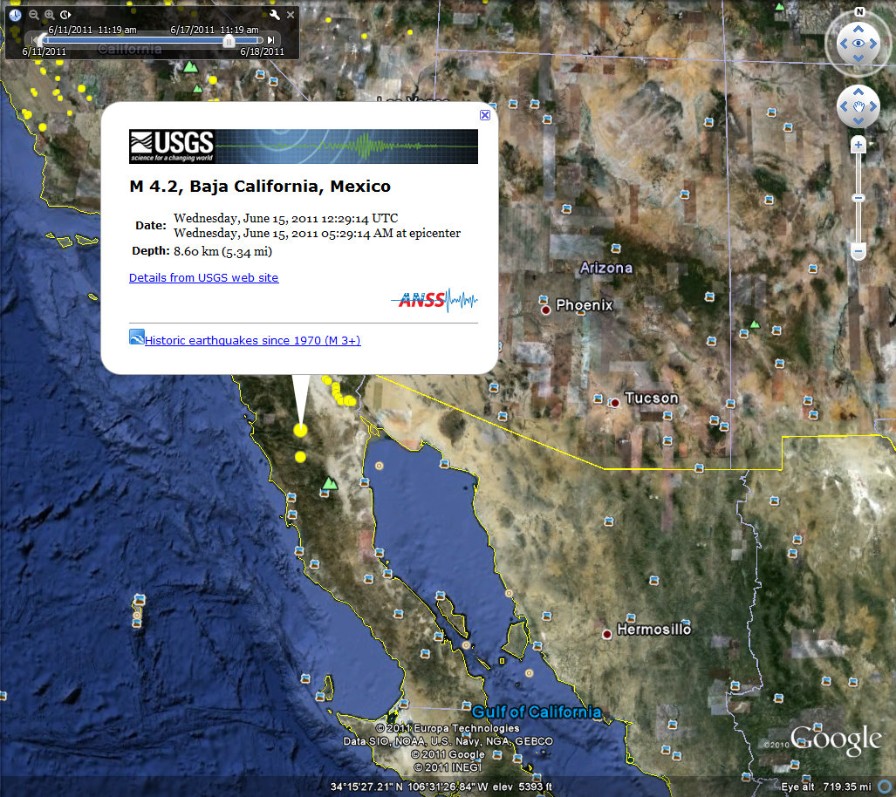
A 4.2 earthquake struck in Baja California, Mexico on Wednesday June 15, 2011 at 5:29AM local time. The focus depth of the earthquake was 8.6km. This earthquake happened along a transform boundary. Earthquakes occur along transform boundaries because two tectonic plates are sliding past one another. This friction creates earthquakes.
Earthquake No. 3
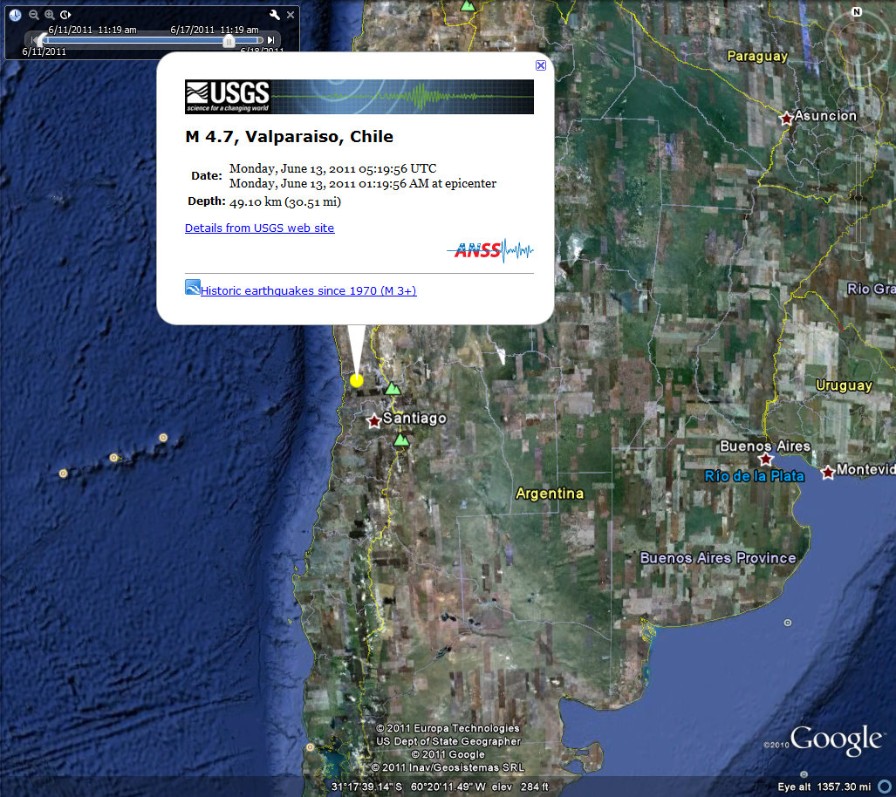
A 4.7 magnitude earthquake struck Valparaiso, Chile on June 13, 2011 at 1:19AM local time. The focus depth of the earthquake was 49.10km. This earthquake happened near an oceanic-continental boundary. Earthquakes occur near oceanic-continental boundaries because plates are colliding, and the higher-density plate sinks beneath the lower-density plate. This process is known as subduction.
Earthquake No. 4
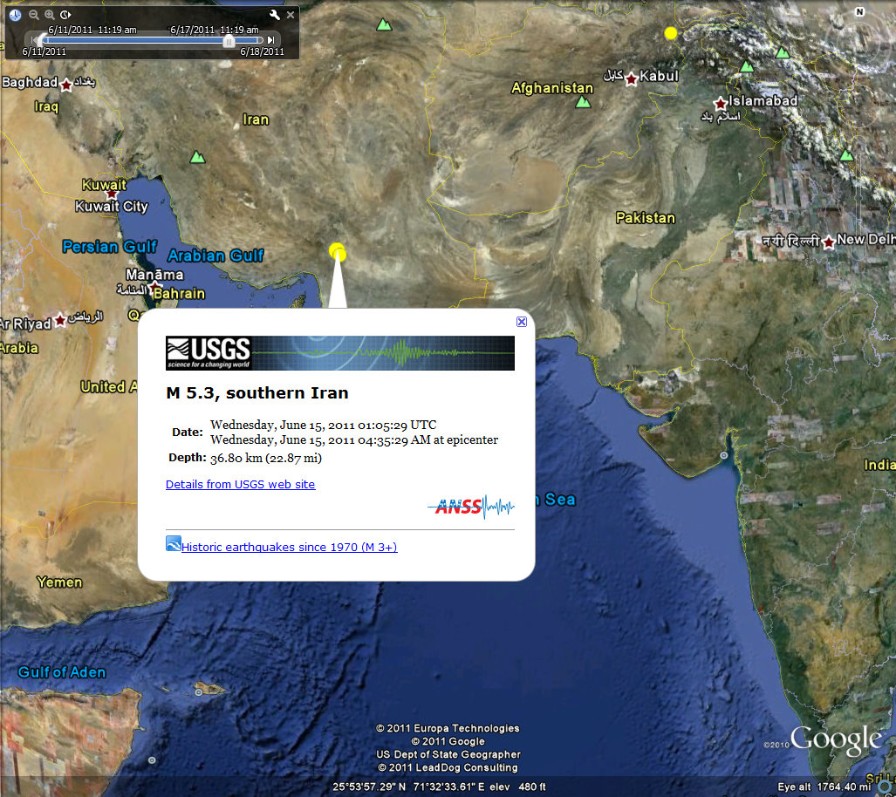
A 5.3 magnitude earthquake struck in Southern Iran on June 15, 2011 at 4:35AM local time. The focus depth of this earthquake was 36.8km. This earthquake happened near a continental-continental boundary. Earthquakes occur near continental-continental boundaries because of subduction, a process where a higher-density plate sinks beneath a lower-density plate.
Earthquake No. 5
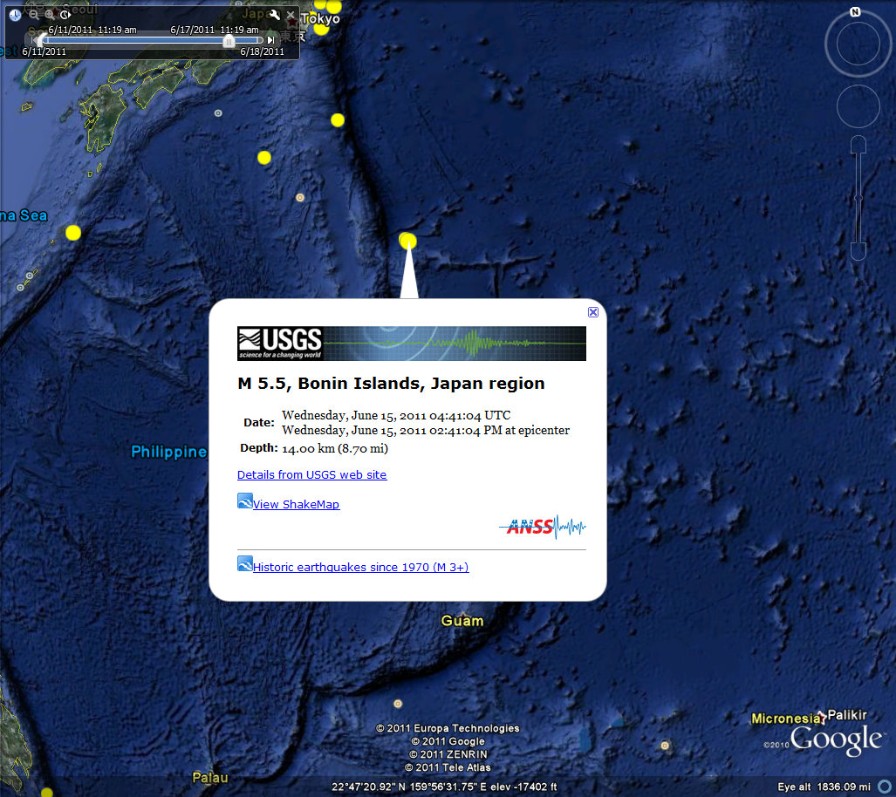
A 5.5 magnitude earthquake struck the Bonin Islands in Japan on June 15, 2011 at 2:41pm local time. The focus depth of the earthquake was 14km. This earthquake occurred near a oceanic-oceanic boundary. Earthquakes happen along oceanic-oceanic boundaries because of subduction, where a higher-density plate sinks beneath a lower-density plate.
Part II: Tracking Volcanoes
Shield Volcano
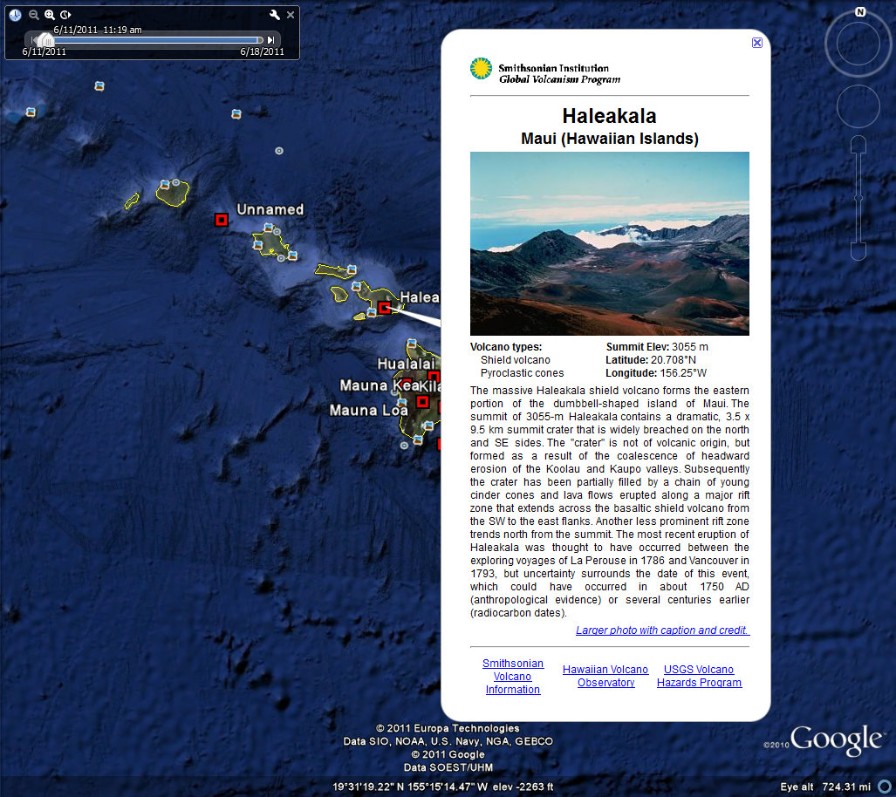
Haleakala is a local name given to the shield volcano on Maui in the Hawaiian Islands. The word "Haleakala" in Hawaiian means "house of the sun." Haleakala forms the eastern portion of the island of Maui. The crater itself is not of volcanic origin, but is formed from erosion and has been filed by young cinder cones and lava flows along a rift zone. Haleakala was formed above a hot spot in the oceanic lithosphere. The Hawaiian Islands were created as a result of eruptions of basaltic lava. The hot spot itself appears to be stationary and the Pacific Plate is moving roughly northwest over the hot spot. This has produced the chain of islands known as Hawai'i.
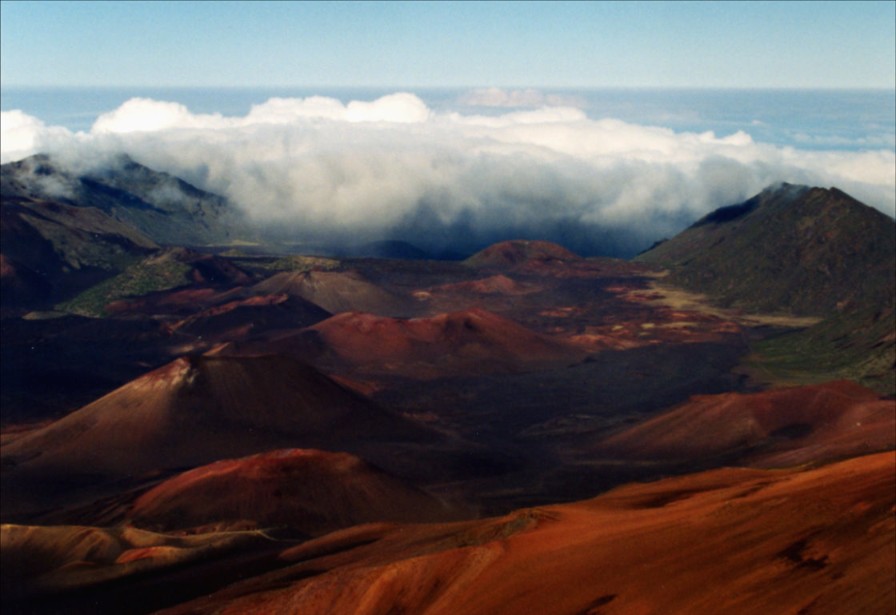
Below is a photograph of the Haleakala Crater, taken a few years ago by my mother-in-law, Sharlene Wells. This photograph shows a closer view of the Haleakala Crater and you can clearly see the cinder cones within the crater. I was recently on the island of Maui with my family and we spent some time at the base of the volcano, but did not have time to travel to the top to see the crater.
Composite Volcano
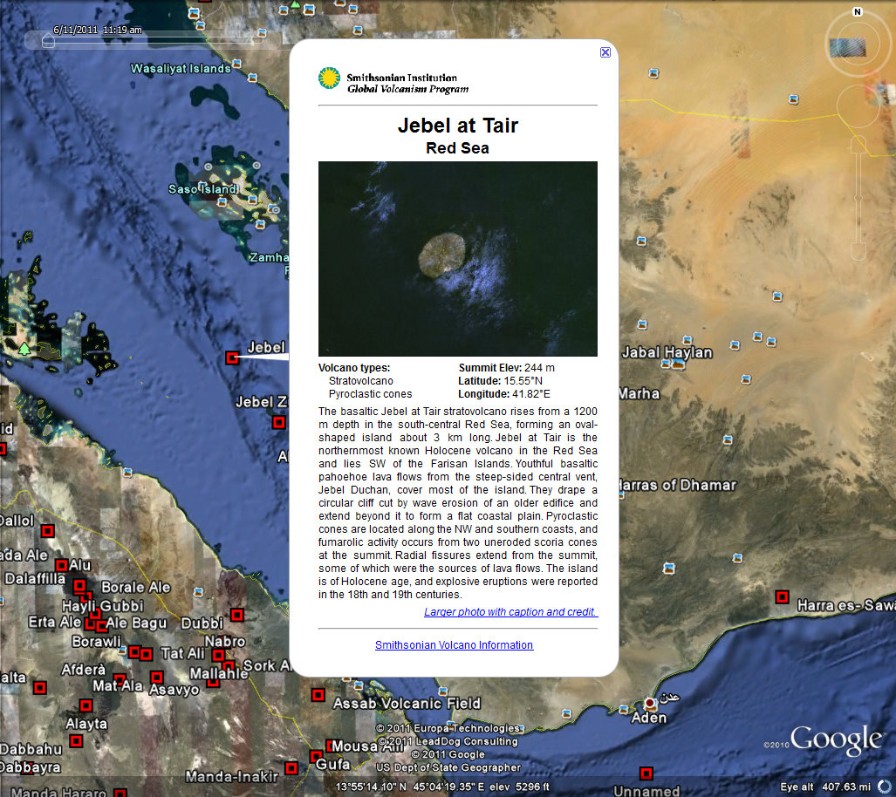
Jebel al Tair in the Red Sea is an example of a Composite Volcano (also known as a stratovolcano). This basaltic volcano is the northernmost known Holocene volcano in the Red Sea. The Jebel al Tair volcano contains both pyroclastic cones (located along
the northwest and southern coasts) and scoria cones (at the summit). Jebel al Tair is located near a divergent boundary. Divergent boundaries happen then tectonic plates move away from each other. The separation of the tectonic plates at a divergent boundary causes seafloor spreading which creates extension cracks. The lithosphere rifts or breaks apart at the cracks, which are then filled with molten rock from below.
Caldera
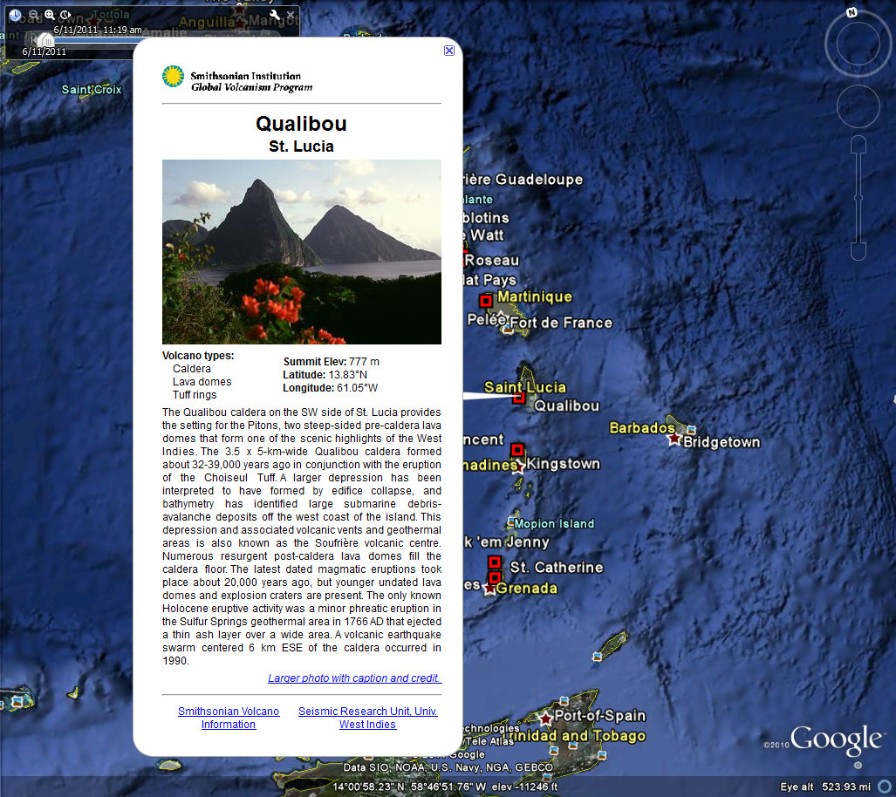
The Qualibou Caldera is located on the southwest side of the island of St. Lucia in the Caribbean. This picturesque caldera was formed over 30,000 years ago. There are large submarine debris-avalanche deposits off the west coast of St. Lucia. In 1990, a volcanic earthquake swarm occurred 6km ESE of the caldera. Within this caldera, there are lava domes and explosion craters. The Qualibou Caldera is associated with an oceanic-oceanic convergent zone where the South American plate is being subducted under the Caribbean Plate.
Cinder Cone
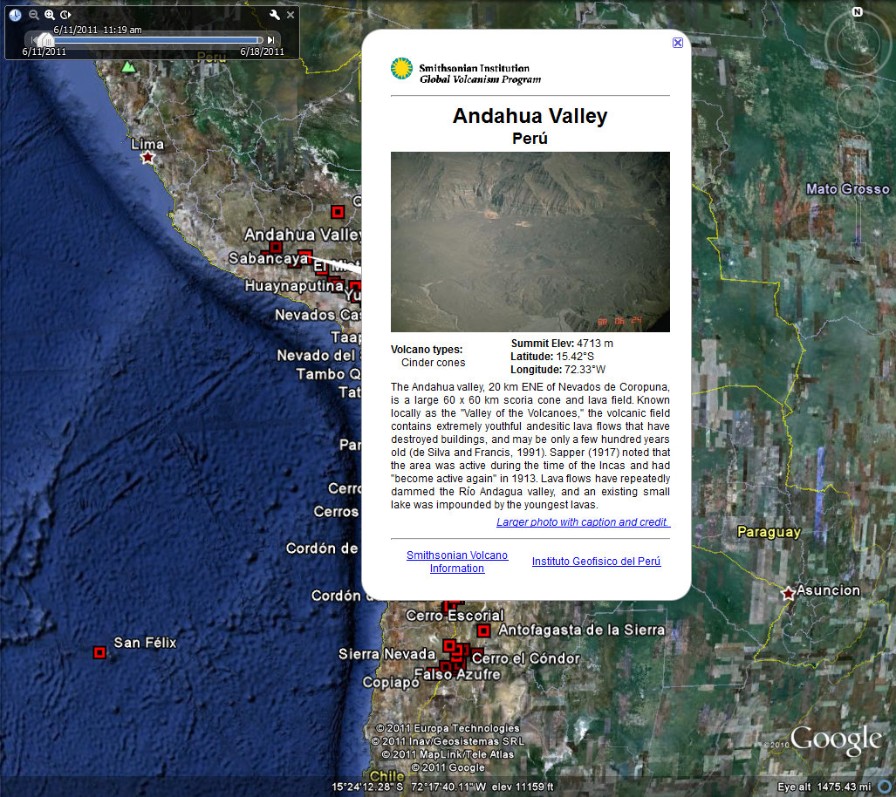
The Andahua Valley in Peru is a large scoria cone and lava field. This lava field and cinder cone are a result of subduction along a convergent boundary where the Nazca Plate is subducting under the South American Plate. This lava field is known locally as the "Valley of the Volcanoes." The Andahua Valley has produced andesitic lava flows that have destroyed buildings, dammed the Rio Andagua valley and impounded a small lake.
Part III: Assignment Reflection
Both earthquakes and volcanoes generally happen along tectonic plate boundaries. The correlation between earthquakes and volcanoes has to do with internal heat. “Volcanic activity requires a source of internal heat, and it is the escape of this heat that fuels plate tectonics,” (USGS – Some Unanswered Questions). There are two sources of internal heat within the earth – radioactive decay and residual heat. “Radioactive decay from naturally occurring chemical elements releases energy in the form of heat, which slowly migrates toward the Earth’s surface” (USGS – Some Unanswered Questions). Residual heat comes from gravitational energy that is left over from the formation of the earth. The escape of the internal heat is what causes the tectonic plates to move. Earthquakes occur because of the movement of tectonic plates.
An example of earthquakes occurring because of the movement of tectonic plates can be seen at the San Andreas Fault. “The San Andreas fault zone separates the Pacific and North American Plates, which are slowly grinding past each other” (USGS Plate tectonics and people). There are two types of fault segments along the San Andreas fault. Creeping segments experience frequent small to moderate earthquakes. These types of segments experience little or no damage from the smaller earthquakes. Locked segments store energy that can build up for many years and when the energy is unleashed, devastating earthquakes occur.
The spatial relationship of earthquakes and volcanoes, as well as their distribution are related. Looking at the real time map on Google Earth, they appear to be mostly located along the “ring of fire” where the Pacific Plate collides with other tectonic plates. There is a divergent plate in East Africa where there are volcanoes. There are volcanoes and recent earthquakes where the Caribbean Plate meets the North American Plate. Earthquakes and volcanoes both happen along plate boundaries.
Before starting this course, I knew little about earthquakes and volcanoes. I have learned what causes earthquakes and that they occur along the boundaries of tectonic plates. It has been interesting to learn that an earthquake or a volcano can trigger a tsunami. I did not know that some volcanoes on the earth are dormant and some are active. I learned that there are benefits from a volcanic eruption. Even though volcanoes can be extremely destructive, the breakdown of volcanic rock has created some of the most fertile soil on earth. It was interesting to learn from the Google Earth map that there is a volcanic field in Nigeria called the Bui Plateau. I also learned that there are three volcanic fields and a cinder cone in Utah.
Now that I understand the concept of earthquakes and volcanoes, I realize that I need to be prepared for a natural disaster in whatever area I am in. Natural disasters happen all over the world. No matter where you live, there is a possibility of a natural disaster. If you live near the ocean, a tsunami is possible. Living in Utah brings the possibility of an earthquake. The central part of the United States experiences tornadoes. No matter where you live, natural disasters can happen. It is important to be prepared with a 72-hour kit. It helps to have knowledge of which disasters happen in certain areas.
