Gbenga Oyewole
Lara Candland Asplund, Instructor
English 2010-045
1 August 2012
Reflective Essay
For this course, I have worked within a group to write about children and social media. I chose this topic because I have an interest in it. I have a son who is almost three years old, and although he isn’t old enough yet, he will soon want to use social media websites. It is my responsibility to understand the potential dangers of social media websites and educate myself to ensure that he is safe when he uses the internet. I have written a report, a position and proposal paper, and a profile relating to the topic of Children and Social Media. I chose to focus on the aspect of online sexual predators. I chose this topic so that I can protect my own son and hopefully others will read my articles and learn how to protect their children.
In the process of writing I have learned how to research and locate articles that were useful in writing a particular genre. For my position paper, I learned how to fairly address both sides of the issue. I have discovered that not all online sources are reliable. Publications from governmental agencies and educational facilities are generally reliable, although some may be biased. It has been interesting to learn which types of articles would be useful for a report, and which ones would be better for a position or proposal paper. Some articles have information that will be useful for my topic, no matter which genre I choose to write in. While writing the profile I learned how to adapt my writing style in order to give the reader interesting personal details. The use of graphics, photographs, charts and statistics to support information within a paper is an important thing I learned. I also found that a report would require different graphics or charts than a position or proposal and a profile paper would be better with more photographs. When one is writing a profile paper, it is not a history or biography. A profile gives a background of who the person is and what they do.
From the peer reviews, I learned that I need to take a more personal approach for my position. My peers suggested that I use examples or stories to support my position and photographs will make the statements more personal. Graphs and charts are useful, but a photograph can draw the reader in more effectively. Peer reviews of the profile suggested the use of additional photographs, which I incorporated into my final draft.
I have done my best to cite my sources appropriately and have referenced the textbook for the course to ensure that MLA format is done correctly. It is important to make sure that credit is given to the original author so that I do not plagiarize.
To ensure that there are a minimum of errors, I have learned to print a hard copy. When reading the article on the computer screen, I find that it is easy to miss errors although Microsoft Word is helpful in correcting spelling and grammar. If I read a hard copy aloud, I can find places where changes need to be made.
It has been very helpful to my writing to be able to read the papers of those in my group, as well as some of the papers from other groups. The peer reviews I have done for my group have helped me to see where I can improve my own writing. I have enjoyed experiencing the writing styles of others and seeing the way they use graphics, stories, and examples to enhance their writing.
Gbenga Oyewole
Lara Candland Asplund, Instructor
English 2010-045
1 August 2012
Children and Social Media
Report
The technological advances in the past 15 years have made it possible for the rise of social media websites. Most homes in the United States have a computer. Many children have access to smart phones that allow them to connect to the internet. With the ease of access to computers and smart phones, children are able to connect to the internet at any time of the day. A study from Pew Internet Research shows that sixty-eight percent of children age 12-17 use social networking sites to communicate with friends. Forty-two percent log on every day. (Gross, p.1). This access to social media puts children at risk of being targeted by a sexual predator. These predators commit crimes that involve sexual acts with a minor and child pornography.
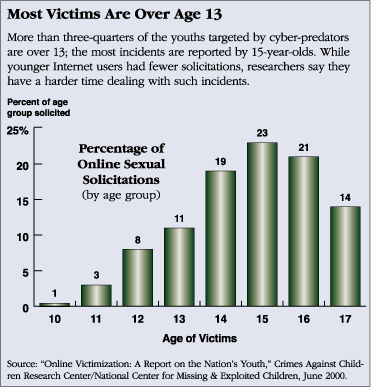

Figure 1: Hansen, p. 173
The Negative
- The Threat to Children
Approximately one in
five children who regularly surf the internet received unwanted sexual
solicitations in 1999. (Hansen,
p.172). It is very likely that number
will increase as more children have access to the internet.
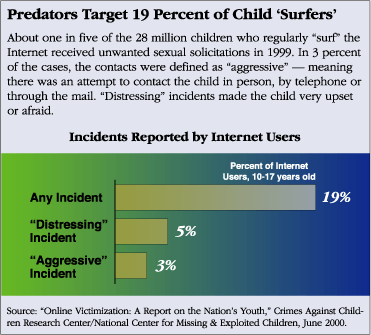

Figure 2: Hansen, p. 172
Online predators search for victims by age, hobbies and geographic location. They use a tactic called “grooming” to gain the trust of their victims. These predators pretend to share the same interests as their victims. They spend time talking about the interests of the victims and their feelings. They lie about their age and usually use a fake name. Another tactic is to boost the self-esteem of the victim, saying that the victim is intelligent, mature, and beautiful or handsome. Children who think that they are not pretty or popular enough respond to a predator’s assurance that they are beautiful on the inside. (Hansen, p. 174, 183). Children who are targeted by sexual predators may become victims of sexual assault or child pornography.
Predators are using technology to aid in the production of child pornography. They use webcams and smartphones to record videos of their sexual abuse of children. Then they share those videos with others via the internet. Because of the new technology, child predators are able to find communities of others who abuse children. They have access to chat rooms where they can share images and videos of their sexual acts with children. They share advice with each other and “encourage and embolden each other to act on their desires to sexually exploit children.” (McQuade, P.1).
Child pornography is a lucrative business for those who are involved. It generates $3 billion annually. (https://wsr.byu.edu/pornographystats). Prior to being shut down by law enforcement, an online child-porn enterprise in Fort Worth, Texas grossed up to $1.4 million per month. Internet Service Providers benefit financially from child pornography websites. (Hansen, p.177)
- Internet Service Providers do not monitor their networks.
Internet service providers (ISPs) have advanced search and filtering technologies. These could be used to help find and stop child pornographers and stalkers. They could hire individuals to enforce corporate policies against pornography and child exploitation. ISPs could block access to adult sites so that minors could not enter. They could block porn-spam. But they don’t. (Hansen, p. 185). They don’t do any of these things that would protect children. It may be because they would lose customers. Revenue could drop. Their business is about making money, not child safety. The average child-porn Web site nets up to $3,000.00 per month for the host ISP. (Hansen, p. 177).
ISPs leave the protecting to the parents, who are sometimes uneducated about internet technology which leaves their children vulnerable.
The Positive
- Parents can protect their children from predators.
Placing the computer in a high-traffic area of the home is a good way to monitor what your child is doing on the internet without invading their space. It would be difficult for a predator to lure a child whose conversations are being monitored by a parent. Also, with a parent watching a child will be less likely to access internet porn sites.
It is important to talk to your children potential online dangers.
· Tell your children to never give out personal information online.
· Use parental control software that monitors the child’s online activity.
· Parental control software also allows you to choose what can be viewed on the internet.
· Monitor your child’s use of social networking sites like MySpace and Facebook. Regularly check their profile to make sure no personal information is posted and assure they are talking to people they know.
· If your children use chat rooms, make sure you know which ones they are using and who they are talking to. Check the content of the conversations in those chat rooms to make sure it is appropriate.
· Tell your child never to respond to instant messaging or emails from strangers.
· If your children use computers at friend’s houses, libraries or their school, find out what the safety guards are on those computers.
· If your child decides they want to meet someone online in person, tell them that you have to accompany them and the meeting must be in a public place. (Sexual Predators, p.1)
The number of hours a child spends on the internet should be limited. Share an e-mail account with your child and put filters on internet mail. Most households do not filter internet mail.


Figure 3: Hansen, p. 176
- Children can surf the internet safely.
With some basic rules and parental monitoring, children can be safe when surfing online. Children should agree to the following rules when surfing the internet:
· Tell a parent right away if something makes them feel uncomfortable.
· Never agree to an in-person meeting with someone online without taking a parent along.
· Do not send pictures and other personal material without parental permission.
· Do not download anything from a stranger.
· Never respond to messages that are suggestive, obscene, belligerent, or threatening. Give any such messages to a parent. (Hansen, p. 183)
- Police task forces work to catch cyber predators.
In 1998, Congress and the Department of Justice launched the Internet Crimes Against Children (ICAC) program. This program provides federal funds to state and local law-enforcement agencies. Specialized units are formed to investigate computer-facilitated crimes against minors. As of 2002, thirty ICAC task forces have arrested more than 900 people. (Hansen, p. 172). Between 2000 and 2006 there was a twenty-six percent increase in arrests of offenders who solicited youth online for sex. (Wolak, Finkelhor, Mitchell, p. 2).
Law enforcement agencies have assigned officers to go under-cover in chat rooms and on social networking sites. These officers participate in “sting operations” and pretend to be young girls or boys. Officers participate in conversations, develop a relationship with the predator and wait for them to suggest an in-person meeting. When the time for the meeting arrives, the predator is surprised to find a law enforcement officer instead of a child. Officers also watch file-sharing sites and conversations in chat rooms in order to catch child pornographers. (Gonzalez, p. 2). As a result of these “sting” operations, many online sexual predators and child pornographers have been arrested and convicted.
Officers arrested Thomas Reedy, the operator of the Fort Worth, Texas based child pornography website. Mr. Reedy was sentenced to 1,335 years in prison. His wife, the bookkeeper for the company, was sentenced to 14 years. More than 100 of his customers have been arrested and charged with possession of child pornography. Some of those customers were linked to actual crimes against children. (Hansen, p. 186).


Figure 4: Hansen, p. 177
The ICAC investigations and sting operations are helping to crack down on child pornography and cyber predators. Cracking down on child pornography is the key to eliminating sexual predators. (Hansen, p. 186).
Conclusion
Children have a variety of options for accessing the internet. Home computers and laptop computers are readily available. Most homes have some type of computer, and computers are available at public libraries and schools. Children have access to smartphones. Because over half the children ages 12-17 in the United States use social networking sites, it is important to protect them. Online sexual predators groom their victims and build trust before luring them into sexual acts or pornography. Internet Service Providers do not protect children. Law enforcement agencies are working to catch these predators, but there are still sexual predators online. It is critical that parents are aware of their children’s internet activities and set rules to protect them.
Works Cited
Gonzalez, Veroniza. (2012, Apr 16). Chesapeake sleuths hunt for child-porn predators. The Virginian-Pilot. Web.
Gross, Doug. (2009, Nov 02). Social Networks and Kids: How young is too young? CNN Tech. Web.
Hansen, Brian. (2002, Mar 1). Cyber-Predators. CQ Researcher. Web.
McQuade, Barabara. N.d. Child Predators Use Technology to Exploit Children. Offices of the United States Attorneys. Web. 2012, June 18.
Sexual Predators in Cyber Space. SexInfo. University of California Santa Barbara. Web. 2012, June 18.
Wolak, Janis, David Finkelhor and Kimberly Mitchell. Trends in Arrests of “Online Predators.” Crimes Against Children Research Center, University of New Hampshire. Web. 2012, June 18.
Women’s Services & Resources. https://wsr.byu.edu/pornographystats.com. N.d. Web. 2012, 5 Jul.
Gbenga Oyewole
Lara Candland Asplund, Instructor
English 2010-045
1 August 2012
Children and Social Media
Position/Proposal Paper
Introduction
Some people view cyber-predators as a major threat to children. “Through the media, parents are convinced that MySpace is ripe with sexual predators.” (Greenblatt, p. 732). Many children receive unwanted sexual solicitations through email. Others argue that internet sexual predators are of little concern given the fact that most sexual abuse is committed by a family member or acquaintance of the child. It can be said that those who use chat rooms for sexual conversations are merely acting out a fantasy and do not intend to actually commit a sexual act with a minor. I believe that sexual predators are a threat to our children and are using the internet to target them. Parents need to protect their children from these predators. Are you comfortable with who your child is talking to on the internet?


Figure 1: http://www.scholastic.com/resources/article/keeping-kids-safe-online
It’s Just a Fantasy
While most people use internet chat rooms to have legitimate conversations, some chat rooms are dedicated to sexual conversations. People visit them for stimulation and arousal. There are those who allege that visiting a sex chat room doesn’t mean that they are going to assault a child. One may not realize that the person they are chatting with, who states that they are a child, is actually a child. Those who visit the sexually based chat rooms often intentionally lie about one’s age and gender. “People go online to play roles and act out their sexual fantasies. Sometimes, people fantasize about conduct which, if they really did it, would be illegal,” says Marvin D. Miller, a defense attorney in Alexandria Virginia. (Hansen, p. 184.)
Most sex offenders are family members or otherwise acquainted with their victims. Fifty-nine percent of sex-offense cases occur among friends of the victims. Family members are responsible for 34% of juvenile sex crimes, while strangers are responsible for only about 7% of reported cases of juvenile sex crimes. So the threat of an internet sexual predator molesting a child is much less than the threat of a family member or friend. (Greenblatt, p. 724, 728).
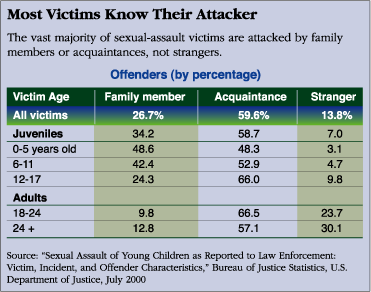

Figure 2: Greenblatt P.728
According to recent information, the rate of child sexual abuse has dropped significantly since 1991. Greater awareness and improved parenting skills have likely contributed to the decline in sexual abuse of children. There are also more effective treatments available for family and mental health problems, such as counseling and psychiatric medications. (Greenblatt, p. 724).
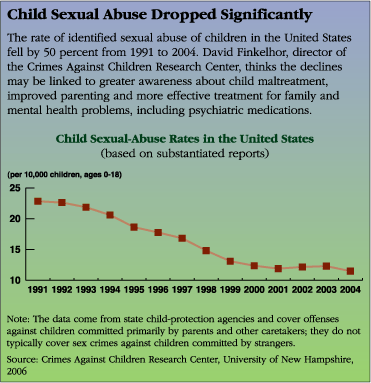

Figure 3: Greenblatt p. 724
Even though those who visit chat rooms to act out sexual fantasies may not believe that the person they are talking to really is a minor, it is possible. Even if the chat room has a minimum age, it would be easy for a young girl to lie and say she is older. She may even admit her actual age. Even though there is a lesser threat of sexual abuse by an internet sexual predator, it doesn’t mean that one shouldn’t take that threat seriously. While it is commendable that the rate of child sexual abuse has dropped significantly, there are still many cases reported every year.
Internet Sexual Predators are a Threat to Children
I believe that internet sexual predators are a real threat to our children. If even one child is harmed by a sexual predator, that is too many. Approximately one in five children who regularly surf the internet received unwanted sexual solicitations in 1999. (Hansen, p.172). It is very likely that number will increase as more children have access to the internet.
Online predators search for victims by age, hobbies and geographic location. They use a tactic called “grooming” to gain the trust of their victims. These predators pretend to share the same interests as their victims. If a child has personal information posted on sites such as MySpace or Facebook, a predator can obtain that information and use it to create a bond with the child. Predators spend time talking about the interests of the victims and their feelings. Many lie about their age and use a fake name. Another tactic is to boost the self-esteem of the victim, saying that the victim is intelligent, mature, and beautiful or handsome. Children who think that they are not pretty or popular enough respond to a predator’s assurance that they are beautiful on the inside. (Hansen, p. 174, 183).
In 1988, Congress passed the Child Protection and Obscenity Enforcement Act which outlawed the use of computers to distribute or receive child pornography. The law had little effect. (Hansen, p.182). Technology aids in the production and distribution of child pornography. Webcams and smartphones are used to record videos of sexual abuse of children. Those videos can be posted for others to view via the internet. (McQuade, p.1). The internet permits access to pornographic images from all over the world, at any time or place. It allows for potentially anonymous viewing of pornographic images. Pictures and videos with sound can be conveniently stored with relatively little expense. (Wortley and Smallbone, p.8).
Because of the availability of advanced technology, child predators are able to find communities of others who abuse children. They have access to chat rooms where they can share images and videos of their sexual acts with children. They share advice with each other and “encourage and embolden each other to act on their desires to sexually exploit children.” (McQuade, P.1).


· Every second $3,075.64 is being spent on pornography.
· Every second 28,258 Internet users are viewing pornography.
· Every second 372 Internet users are typing adult search terms into search engines. (www.familysafemedia.com/Pornography_statistics.html).
One of the major issues found in a recent study is that “parents simply ignore their children’s activities on MySpace.” (Greenblatt, p. 732). When parents are not aware of what their children are doing on the internet, or whom they are talking to, that places the children at a higher risk of being targeted by an internet sexual predator.


Figure 4: http://www.pc1news.com/news/0171/what-every-parent-should-know-internet-safety-for-children.html
Proposal
Parents can protect their children from predators.
Placing the computer in a high-traffic area of the home is a good way to monitor what your child is doing on the internet without invading their space. It would be difficult for a predator to lure a child whose conversations are being monitored by a parent. Also, with a parent watching a child will be less likely to access internet porn sites.
It is important to talk to your children potential online dangers.
· Tell your children to never give out personal information online.
· Use parental control software that monitors the child’s online activity.
· Parental control software also allows you to choose what can be viewed on the internet.
· Monitor your child’s use of social networking sites like MySpace and Facebook. Regularly check their profile to make sure no personal information is posted and assure they are talking to people they know.
· If your children use chat rooms, make sure you know which ones they are using and who they are talking to. Check the content of the conversations in those chat rooms to make sure it is appropriate.
· Tell your child never to respond to instant messaging or emails from strangers.
· If your children use computers at friend’s houses, libraries or their school, find out what the safety guards are on those computers.
· If your child decides they want to meet someone online in person, tell them that you have to accompany them and the meeting must be in a public place. (Sexual Predators, p.1)
It is important to limit the number of hours a child spends on the internet. Share an e-mail account with your child and put filters on internet mail. Most households do not filter internet mail.
Children can surf the internet safely.
With some basic rules and parental monitoring, children can be safe when surfing online.
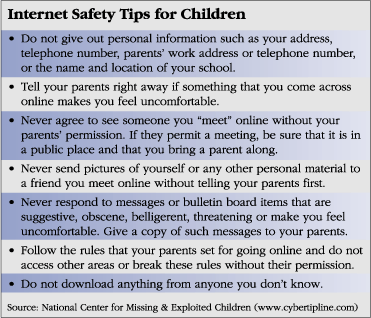

Figure 5: Hansen, p. 183
Police task forces work to catch internet sexual predators.
Law enforcement agencies have assigned officers to go under-cover in chat rooms and on social networking sites. These officers pretend to be young girls or boys. Officers participate in conversations, develop a relationship with the predator and wait for them to suggest an in-person meeting. When the time for the meeting arrives, the predator is surprised to find a law enforcement officer instead of a child. As a result of these “sting” operations, many internet sexual predators have been arrested and convicted.
In 1998, Congress and the Department of Justice launched the Internet Crimes Against Children (ICAC) program. This program provides federal funds to state and local law-enforcement agencies. Specialized units are formed to investigate computer-facilitated crimes against minors. As of 2002, thirty ICAC task forces have arrested more than 900 people. (Hansen, p. 172). Between 2000 and 2006 there was a twenty-six percent increase in arrests of offenders who solicited youth online for sex. (Wolak, Finkelhor, Mitchell, p. 2).
Officers arrested Thomas Reedy, the operator of the Fort Worth, Texas based child pornography website. Mr. Reedy was sentenced to 1,335 years in prison. His wife, the bookkeeper for the company, was sentenced to 14 years. More than 100 of his customers have been arrested and charged with possession of child pornography. Some of those customers were linked to actual crimes against children. (Hansen, p. 186).
The ICAC investigations and sting operations are helping to crack down on child pornography and internet sexual predators. Cracking down on child pornography is the key to eliminating sexual predators. (Hansen, p. 186).
Castration could prevent repeat offenses.
James Jenkins was sent to a sex-offender treatment center after molesting three young girls. Before he arrived at the treatment center, he castrated himself. “Castration has done precisely what I wanted it to do,” Jenkins said. “I have not had any sexual urges or desires in over two years. My mind is finally free of the deviant sexual fantasies I used to have about young girls.” Eight states allow castration by surgical or chemical methods. (Greenblatt, p. 727). Surgical castration is performed by excision of both testes. This results in decreased sexual drive and activity. It is a permanent procedure. Repeat sex offenses of those who are surgically castrated are approximately 1 percent. (Pitula, p. 10).
Chemical castration is performed by administering medication which reduces testosterone levels. Testosterone is linked to aggression, and testosterone levels become elevated with sexual activity. The goal of chemical castration is to lower testosterone levels, thereby lowering sexual arousal and urges. (Pitula, p. 11-12)
If more states had harsher punishments for sex offenders, such as castration, it is possible that the rate of sexual abuse would further decline.
Conclusion
Most child sexual abuse cases involve a family member or an adult the child knows. However, experts say online sexual exploitation of children is dramatically increasing. Access to the internet has made children more accessible to sexual predators. (Hansen, p. 171). Because of the advanced technology, creating and distributing child pornography has become relatively easy. Child pornography has become a lucrative business. Internet sexual predators can easily target children and groom them in order to gain their trust. Once trust is established, the child is at risk for sexual abuse. Sexual abuse of children by internet sexual predators needs to be dealt with. Police task forces work hard to catch these predators. Harsher punishments could reduce the rate of child sexual abuse. Parents need to take an active role in their child’s internet activities. Steps can be taken to protect children from internet sexual predators.
Works Cited
Gerber, Lauren. (2008, Aug. 28). What Every Parent Should Know: Internet Safety for Children. PC1News.com Web.
Greenblatt, Alan. (2006, Sep 8). Sex Offenders. CQ Researcher. Web.
Hansen, Brian. (2002, Mar 1). Cyber-Predators. CQ Researcher. Web.
McQuade, Barabara. N.d. Child Predators Use Technology to Exploit Children. Offices of the United States Attorneys. Web. 2012, June 18.
Pitula, Elizabeth. N.d. An Ethical Analysis of the Use of Medroyprogesterone Acetate and Cyproterone Acetate to treat Repeat Sex Offenders. Barnard College. Web. 2012, July 3.
Pornography Statistics. http://www.familysafemedia.com/pornography_statistics.html. N.d. Web. 2012, June 18.
Sexual Predators in Cyber Space. SexInfo. University of California Santa Barbara. Web. 2012, June 18.
Wolak, Janis, David Finkelhor and Kimberly Mitchell. Trends in Arrests of “Online Predators.” Crimes Against Children Research Center, University of New Hampshire. Web. 2012, June 18.
Wortley, Richard, Stephen Smallbone. (May 2006). Child Pornography on the Internet. U.S. Department of Justice, Office of Community Oriented Policing Services. Web.
Gbenga Oyewole
Lara Candland Asplund, Instructor
English 2010-045
1 August 2012
Profile of a Sexual Predator
Introduction
John’s 5-bedroom house in a middle-class neighborhood has beautiful flower gardens. The lawn gets mowed every week. He is active in politics and in his church. He works with the Boy Scouts and enjoys camping and hiking. Together, he and his wife have three children and a dog. His job as a general contractor keeps him busy, but he takes time to be with his family. He often brings in garbage cans for his neighbors. On the surface, he appears to be a devoted husband and father and a good neighbor. But he has a secret.
An Average Guy
At night, John looks in the mirror and decides that, for a 40-year-old, he’s not bad looking. He is Caucasian and stands 5’10”. He has dark brown hair and blue eyes.

Figure 1: http://www.romancescam.com/forum/viewtopic.php?f=3&p=233206
His wife tells him that the children are asleep and she will be going upstairs to read for a while. He tells her he has a project for work and goes to his home-office.
Behind Closed Doors
John He closes the door behind him and sits down at the computer and turns it on. He opens up his favorite child pornography website and starts browsing. John has been viewing pornography since he was 12 years old. It was easy to buy. One of the other boys at school was selling them after taking them from his father’s shelf at home. (Sheehan & Sullivan, p. 151). His interest in pornography developed after being sexually abused by his grandfather when he was between the ages of four and ten. This experience with his grandfather left him confused about sexual contact between adults and children. (Sheehan & Sullivan, p. 149).
When John finishes with the pornography he moves on to a sex chat room. Visiting sex chat rooms is a nightly habit for John. He has even downloaded an application to his I-phone that allows him to visit these chat rooms at any time.


Figure 2: http://itunes.apple.com/us/app/sex-chat/id447699264?mt=8
Tonight, John is meeting Ashley in the sex chat room. A few weeks ago, he viewed Ashley’s profile on Facebook. She is 14 years old and likes rap music, dancing, hiking and travel. John prefers girls between the ages of 14-16. (Buschman, et al. p.205). Ashley just moved to the city John lives in and has had a hard time making friends. John sent her a message and told her that he is 21 years old and attends a local community college. He told her he is majoring in Business Administration. He has been grooming Ashley by telling her he likes the same things she does. He has established a friendship with Ashley, telling her how smart she is. He has helped her overcome her disappointment at not making friends at her new school by being her friend online. (Hansen, p. 182-183). He has gained her trust and she is now willing to meet him in his favorite online sex chat room. They talk about sex and he answers some of the questions she said she doesn’t want to ask her mother. (Wolak, et al, p. 116). Ashley tells John that her parents are going on vacation in the morning and she will have the house to herself. John replies, “I’d really like to meet you in person. Can I stop by while your parents are out of town? We could listen to the new rap CD I just bought.” Ashley agrees and gives John her home address. They agree to meet the following afternoon. John doesn’t realize that Ashley really isn’t a 14 year old girl. He has just agreed to meet an undercover police officer.

Figure 3: Hansen, p.177
The next afternoon, John drives to the address Ashley gave him last night. He finds a note on the door that tells him to come in and wait in the living room. He opens the door, walks into the living room and sets down the six-pack of beer he brought with him. After removing all his clothing, he sits down on the couch naked. He hears footsteps behind him. He turns around expecting to see Ashley but instead finds a team of police officers.
Conclusion
John’s 5-bedroom house in a middle-class neighborhood still has beautiful flower gardens. The lawn continues to be mowed every week. After being sentenced to 18 months in prison, John is currently on parole.

Figure 4: http://sk8rrboi.wordpress.com/2011/02/03/folie-a-deux-behind-bars/
His address is now listed on the sex offender registry. Even though John appears to be a family man, he poses a threat to young girls on the internet.
Works Cited
Buschman, Jos, et al. (2010, Jul). Cybersex offender risk assessment. Journal of Sexual Aggression. Web.
Hansen, Brian. (2002, Mar 1). Cyber-Predators. CQ Researcher. Web.
Sheehan, Valerie and Joe Sullivan. (2010, Jul). A Qualitative Analysis of Child Sex Offenders Involved in the Manufacture of Indecent Images of Children. Journal of Sexual Aggression. Web.
Wolak, Janis, et al. (2008, Feb-Mar). Online “Predators” and Their Victims. University of New Hampshire Internet Solutions for Kids, Inc. Web.
